Category: City News

  • Downey takes a stab at a Public Art Project

    Downey takes a stab at a Public Art Project

    This Tuesday’s city council meeting includes an interesting proposal, the city would like to hire self-described “Traffic and Civil Engineering” firm Hartzog & Crabill Inc. for a couple art projects around the city.   The proposal spends $17700 of the city’s Art in Public Places fund for two projects, both of which say something about the our city’s current relationship with the arts.  You can read about the proposal here at the Downey Patriot.

    A mural depicting the glory days of The Avenue Theatre is interesting.  It dresses up what is currently an open wound in downtown Downey.  It also makes a statement and makes you think.  The city recognizes the theatre’s rich history and that  many of its citizens have been clamoring to “Save the Avenue,” but it also maintains that there is nothing the city can do to save it, beyond wishful thinking.  Excuses abound:  the property was purchased with housing funds, so it has to be housing or we have to pay it back.  It’s also been stated that if a wealthy individual sweeps in with millions of dollars to restore the property and millions more to operate it, that they would certainly entertain the idea.

    The bottom line of it is this: for downtown Downey to ever become anything significant, it needs to have the arts at the center of it.  The downtown strip on Downey Avenue needs an anchor to bring the pieces together, and the mortuary just isn’t cutting it.  We need a venue, preferably a smaller size than the civic theatre a few blocks away.  Something designed to be affordable for local artists to take risks on.  Music, comedy, plays, independent films.  There are options here:  a community arts space with artists lofts built on top (“housing”).  A proposal can be drawn up, and a developer searched for.  The site can be marketed as an arts opportunity– set aside the pretty Tierra Luna proposal and consultants, and draw up something for this.  The city could form an arts commission to figure out how to position the property among developers and arts organizations.

    This mural makes a statement, albeit an ironic one:  We know The Avenue is shuttered and falling apart, so we’ll put up the money to paint over it with a facade depicting a day when it was vibrant and alive.   That will tide us over until the city finally develops its plan to tear down the building and eliminate all traces of it.
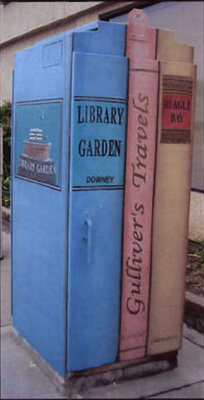
    The second attempted public art project is that we’ll hire the same firm to paint seven utility boxes around the city.  How were the designs for these boxes arrived at?  Did they give a well-known, interesting, respected artist a chance to express themselves and come up with something compelling to paint?  Or how about offering these small projects up to city residents or art students to propose an idea and execute it with financial support from the public art fund?  Maybe an engaging community art contest?  These might be processes I could get behind, and painting utility boxes could be a compelling low-cost project.  However, I’m guessing what probably happened was a quick brain-storming meeting among city officials and design consultants that landed on these pretty decorative designs.  This is not an artistic process, even though a skilled painter is executing it.  This kind of thing should be categorized as craft, or worse: decoration.  Certainly not worthy of a serious Public Arts program.  There’s even a gaudy sign on the bottom of some of these that says “City of Downey,” a clear indication of it’s intended purpose.

    I will applaud one thing, however.  The revisions to the policy manual defining Downey’s Art In Public Places program are a step in the right direction, for now setting aside the dissolution of the AIPP committee.  Moving the program under the auspices of Community Development (instead of Community Services) is the right fit.  Taking away restrictions as to only allowing sculptures is a good thing.  I’m not so sure about loosening the requirements for fountains, however…  and the removal of a requirement that it can’t be near a utility box.

    It’s often said that art is defined by its context.  I’ll add to that that art is defined by the context of the process that it was created.  Involve the community.  Make an organized effort to invite artists to take risks and propose something bold.  Councilman Mario Guerra says that he’s asked the local artists to “step up.”  The Downey Arts Coalition is an attempt to do that– it’s a lot of work, but I think we can put together some interesting things for our city.  Join us at the next meeting if you can.

    Update: The contract was approved, and there has been some public back and forth.  An updated article in the Downey Patriot recaps it… though out of context my quote sure seems extra snarky.  I don’t intend to be someone speaking out against things, but to find a positive initiative to speak out for.  Guerra and Brossmer have offered other utility boxes to be used for local artists, if a plan can be worked out.

  • ‘Rough Start’ at Civic Theatre Premature, Underrated

    ‘Rough Start’ at Civic Theatre Premature, Underrated

    Last week an article came out in the Downey Patriot titled thus: ‘New Era’ Off to a Rough Start. It was referring to a comedy night recently held by H&E Entertainment at the Downey Civic Theatre.  The show undersold, and the producers were disappointed.  They canceled all future bookings for the year, and their disappointment was retold to a Patriot reporter who turned it into a front-page story.  What the article didn’t say, though, was that the light quote, ‘New Era’ was quoting this post from here at the Downey Arts Coalition.  So since they dragged us into it, I guess I’ll respond.  I’m never without opinion, after all.

    First of all, the show had an attendance of 200 out of 350 sold or handed-out tickets.  This is not a failure.  Nor is it even a rough start.  200 butts in seats is a HUGE success, by most standards.  And we are not Center Theatre Group or The Kodak.  200 people is a marvelous turnout for Downey, CA.  Now, it must be said that the theater itself seats over 700.  So in a space that large, 200 is going to feel quite sparse.  This is an indication of a different problem.  Another venue, or a different management of the space perhaps could have helped.  Morale does tend to slump when there are so many empty seats, and that can make the room feel cold and awkward.  Also, when audience is spread out over a larger space, they can’t respond to each other, which limits the amount of laughs something like a comedy show would receive.  So there was definitely a problem here.  But the shear number of tickets should not be knocked.  Good job on getting those 200 people!  Seriously, that is awesome.

    Second, the producers were quoted more than once complaining that those in the community who advocate for the arts didn’t even show up.  Well, if we were the only people you were going for, you’d have about 10 butts in the seats.  We already support the arts.  The people we are trying to reach with this effort are the regular people– those who rarely or never see a DCLO show, Downey Symphony concert, who spend most of their evenings out at Olive Garden and the movies.  These are the people we want to reach in our community.  Artists making art for other artists is nice, but it’s not far-reaching enough.  The purpose of our efforts here is to unify us all as a community.

    Third: okay, you want to fill that house?  You must market.  You must advertise.  You must (here’s the hard part) figure out what this community needs (not just wants, but needs), and how to make them want it.  And you’ve got to deliver.

    Now, as for the New Era and the Rough Start.  The new era to which we are referring is the takeover of the Downey Civic Theatre by VenueTech, a booking company that will bring new acts to the theatre and pretty much bring it back to life.  VenueTech is in residency at the theatre starting in 2011, but they have yet to book their first season.  So the New Era hasn’t really begun.  H&E Entertainment is commendable for bringing some new stuff to the theatre, but VenueTech’s first season will be the lineup that we’re all waiting to hear about.   They also have different plans for the way that the theatre promotes all of its bookings, including the community’s usual theatre and music events, but it all has yet to be implemented.   I do hope that H&E comes back, and that they continue to produce great shows that bring people in.  They are doing great work and shouldn’t be discouraged.

  • A New Era for the Downey Theatre

    A New Era for the Downey Theatre

    On Tuesday the Downey City Council voted to contract with the company, VenueTech Management Group LLC to take over management operations at the Downey Theatre, and to bring a presenting series of concerts with headline acts to the theatre. The official new story is up at the Downey Patriot:

    Downey Patriot – Downey Theater under new management

    This is big news, because it’s a right turn away from the “status quo” that has run our theatre for the last 30 years.

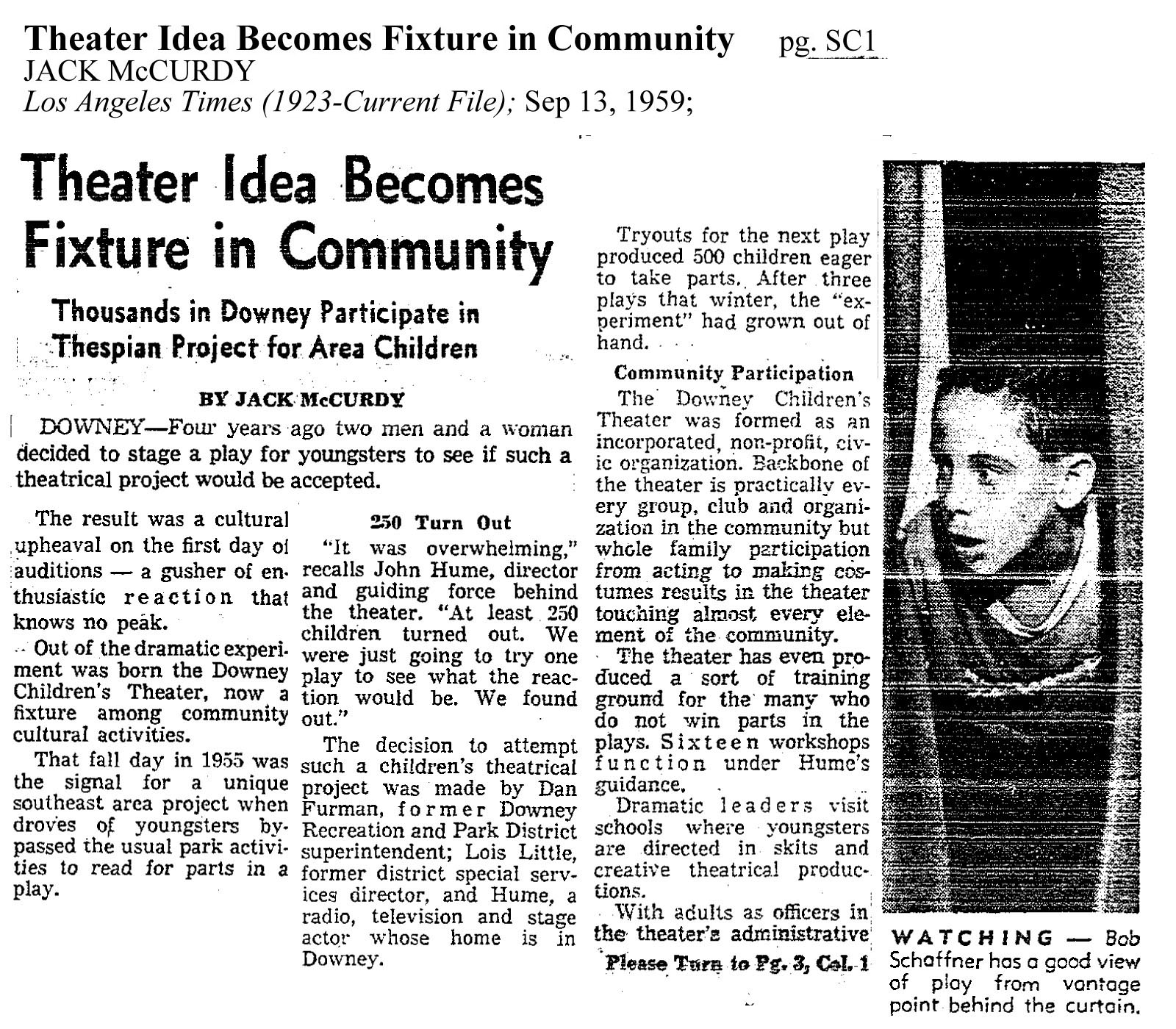
    A bit of history first. Dan Furman (Furman Park) was the first city superintendent of parks & recreation, what is now the Director of Community Services. He met actor John Hume in 1955, who was in town performing for a storefront theatre that was producing shows on Downey Avenue. The idea: start a children’s theatre in Downey that would perform at the Rio Hondo Elementary school auditorium. The Downey Children’s Theatre was birthed, and the idea took off like wildfire. Hundreds of children came to audition, leading to the strong involvement of the community. Very soon the children’s theatre was doing 10 or 11 plays a year, entertaining thousands of residents. It out-grew Rio Hondo very quickly.

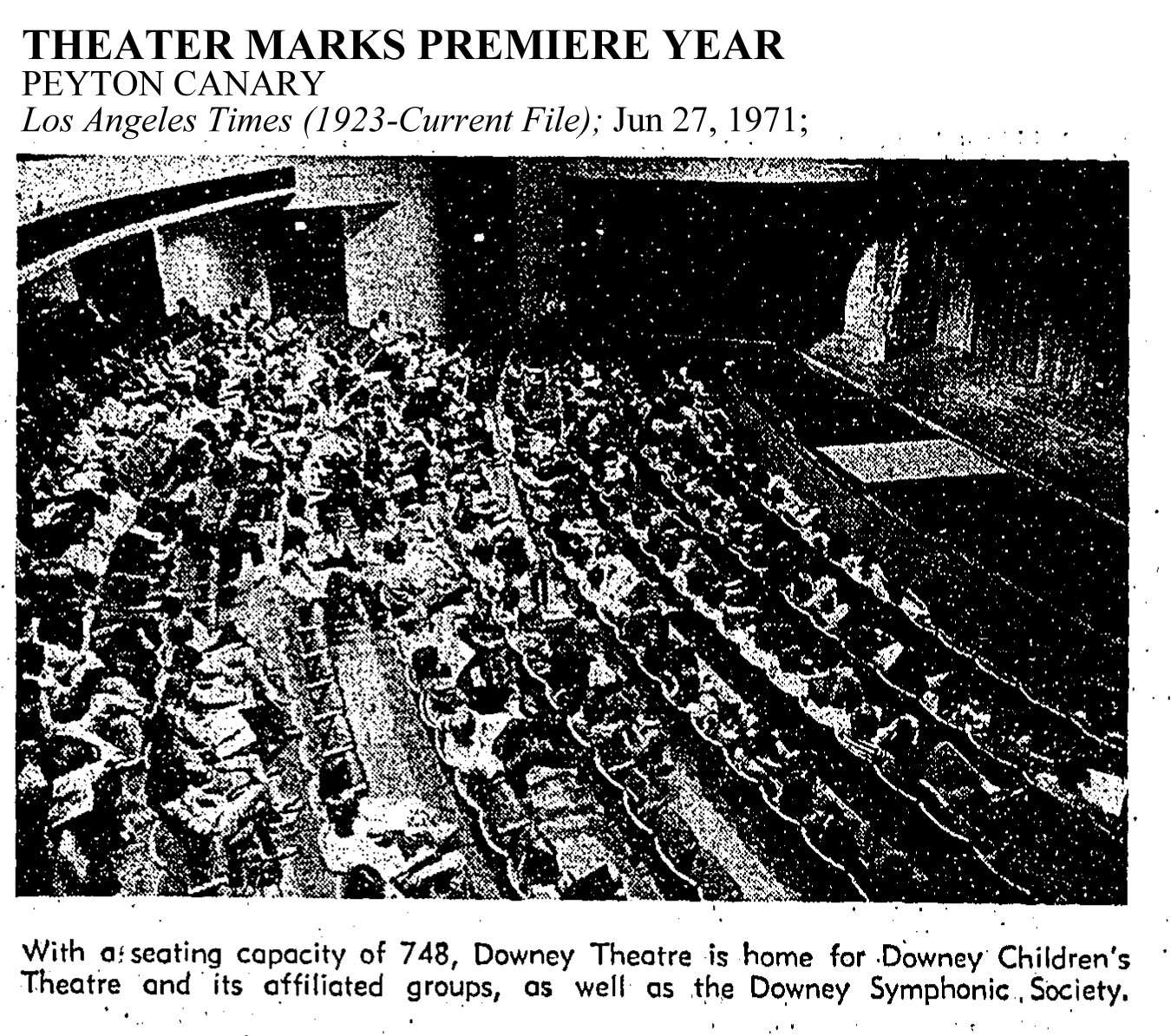
    John Hume, a city employee, lobbied along with other civic leaders for the city to build a theatre. The symphony wanted a 1000 seat house, the theatre wanted only 500. 738 was the compromise. It took a long time and much controversy, but in 1970 the city used cigarette taxes to fund the project. In 1971, the theatre had it’s first banner year. No longer was the city doing only children’s theatre, but also adult plays, experimental plays like “No Exit,” the civic light opera, marionette theatre, and everything in between. Hume was the theatre’s managing director, as well as director of many of the plays.


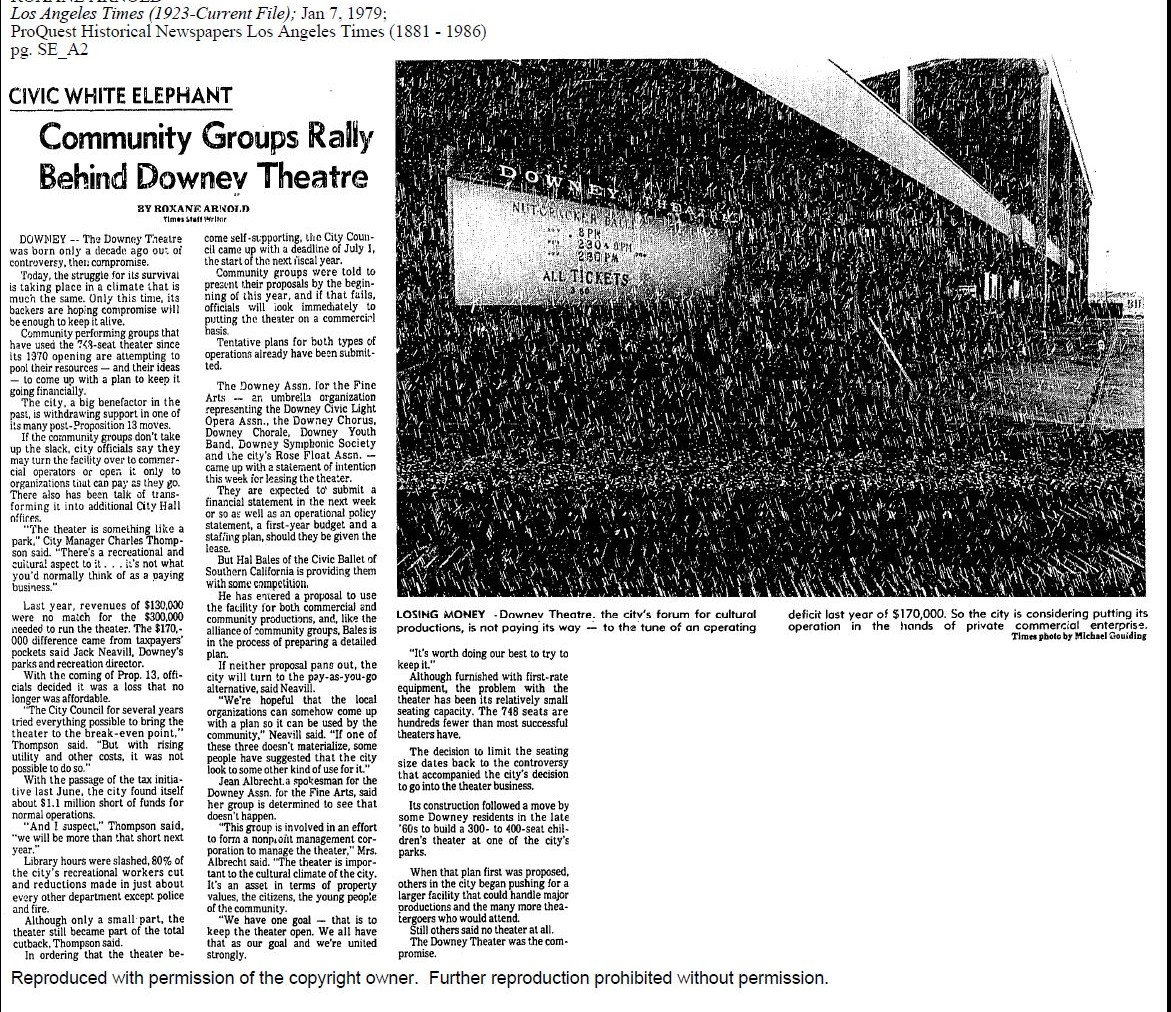
    Then prop 13 happened (restricting property tax rates), leading to the budget crisis of 1978. Among the deep cuts, Hume and his staff were let go, and the theatre operation was stripped down to a minimum. The Downey community arts groups rallied to form a coalition that would continue to operate the theatre with an all-volunteer non-profit model, but that lasted only until 1982 when the city took control of the theatre once again. By now all of the theatre programs shut down except for the profitable Downey Civic Light Opera which continues to run today.

    In 1983, Kevin O’Connor was hired to be the new managing director of the theatre. His first year he even put on a season of 5 performing arts concerts that broke even. I’m not sure if or how long he continued to do that, but it also was eventually left on the sidelines. For a number of years the city also produced the “Way Outer Broadway” talent contest for young talented artists at the theatre, but when the director of that program retired, so did it.

    The Downey Theatre slowly settled into it’s passive rental model that it is today, while other local theatres continued to pursue performing arts acts or resident companies to keep the theatre busy. The Civic Light Opera began to contract and settle in to the model it is today, three musicals of 10 performances each, managing to mostly break even financially without the help of many wealthy patron donors (an amazing feat in these trying days for community theatre). The Downey Symphony has also survived despite challenges, now presenting 3 or 4 concerts a year and usually operating at break-even. Kevin O’Connor continued to keep the theatre as-is, without any major upgrades, marketing or attempts to modernize the box office. After 25 years his final salary was nearly $200,000/year. He retired in 2008 and has not been replaced.

    Along comes 2009, the city of Downey has purchased the shuttered historic Avenue Theatre in a state of disrepair, and announces plans to convert it to a housing development. Downey’s preservationists (George Redfox, Kathy Perez and others) coming off a major success with Jonny’s Broiler, now turned their sights on the Avenue. A “Save the Avenue” campaign was started, as well as a renewed call by others such as Lawrence Christon for the city of Downey to take a hard look at the arts as an important stimulant of culture, community identity and economic development. “Save the Avenue” was met by the city’s reply of “We have the Downey Theatre, we don’t need the Avenue.” Which begged the question: What are we doing with the Downey Theatre? The theatre is dark more than 2/3 of the year. The city council responded with the subcommittee of David Gafin, Roger Brossmer along with Community Services Director Thad Phillips looking into the potential of a private operator to come in and take over management of the theatre. In Brossmer’s words, “We don’t know how to manage a theatre– let’s find somebody that does.” Good call. Honestly, to find a suitable private company that would be interested was a long-shot. VenueTech happens to be a great fit for our size. None of the other proposals were even close to what we were looking for.

    A few important things to note about VenueTech: They’re big into involving the community. They want the city and it’s residents to have ownership of our theatre, and for their name to be completely unknown to the patrons of the theatre. The DCLO, Symphony, school concerts, and local artist groups are a major part of their plan for revitalizing the theatre. With marketing and increased awareness of the big-picture of the theatre, these programs can flourish. The presenting series will complement– but for any act or headliner that they might bring in, they want to be sure that it’s a good fit for our audience. They also want to throw a series of arts-oriented festivals that will take place on the theatre grounds and the courtyard that will bring local artists and residents together around an arts setting. One of their first jobs will be to create a non-profit “Downey Theatre Foundation” that will be community run in order to organize fundraising and volunteer efforts. They want to implement a ticket surcharge for all events that will go into pool a fund that young and developing artists can apply to for financial assistance with new projects. Lastly, most of these changes will take time, and are focused on long-term development.

    I’m hoping this new non-profit can provide a framework and training for our community advocates to learn how to fund-raise and start new programs to stimulate local talent and developing artists. Having acts like Chris Botti playing at the theatre is nice, but it doesn’t develop Downey’s own artistic voice. That’s why I’m excited about VenueTech’s stated desire to work with the community– hopefully it will give us a better chance to take ownership.

    There was resistance at the council meeting, mostly due to part of the community feeling rail-roaded into this new regime. Has this been thoroughly thought through? Are they going to push aside our city organizations for their own agenda? Do we have unrealistic hopes about what the Downey Theatre can be? I do think that the city should have tried harder to bring together more of the local arts community to hear VenueTech’s proposal and presentation, before the night of the city council meeting. In fact, if it wasn’t for the fact that I saw this on the agenda and emailed everybody I knew about it, half of the arts people who were there to listen wouldn’t have been there. They mentioned at the council meeting that VenueTech had the opportunity to meet with the DCLO, the Symphony, and the school district. Two people were there– a rep of the symphony and Marsha Moode of the DCLO. The presentation was made, but from what I hear, there wasn’t much discussion (on our part) beyond protecting dates on the schedule and rental rates.

    The future is still uncertain, but so far it’s at least a change with a lot of good potential. An arts renaissance must come from a city’s resident’s, not the city staff and council, that’s the part that I’m more concerned with. I put out a renewed call to the city council during the meeting: Form an official city “arts task force.” To talk about these issues on a monthly basis and come up with a framework for Downey’s approach to the arts. How hard can that be?

  • VenueTech Proposal to Manage Downey Theatre

    VenueTech Proposal to Manage Downey Theatre

    This Tuesday, November 23, the Downey City Council will take up the question of whether or not to contract with VenueTech (http://www.venuetech.com) to manage the Downey Civic Theatre. VenueTech would take over all day to day operations of the theatre, including hiring a full time theatre manager and other theatre staff to handle all the production needs. In addition, VenueTech would use their knowledge and contacts in the performing arts industry to book touring shows and popular acts to the theatre, creating a programming plan or a series of events produced by the city and VenueTech. They would take over all rental agreements, price negotiations, talent contracts, marketing and technical coordination.

    From their website: “VenueTech Management Group, LLC is a consulting and management firm involved in the business planning, capital development and direct management of community-based organizations and public assembly facilities. A significant portion of the firm’s business is focused on the restoration and reuse of historic buildings and the use of entertainment, cultural arts and public venues as a catalyst for economic development.” They are based in San Francisco and directly manage five other public theatres in California.

    To read the full contract, CLICK HERE. The initial summary is interesting, then it gets a little technical. Page 21 starts more of the plans.

    The initial term of the agreement is from 2011 to 2015. There are additional costs to the city, as there should be. This year, and additional $208,000 to get set up. Some will be offset by increased revenue, but not all. Our city does not invest in its theatre nearly as much as our nearby competitors La Mirada and Cerritos, so we shouldn’t blink at what is actually a small amount. The investment will bring a better quality and number of performances to the Downey Theatre over time, serving the community. In addition, VenueTech will create a non-profit 501c3 that will support the Downey Theatre with the involvement of community leaders and arts advocates. It seeks to build up a fundraising and volunteer organization to support the theatre. VenueTech states that they have as part of their vision for the Theatre to learn about and involve the commmunity, supporting our current companies “in residence” such as the Downey Civic Light Opera, Downey Symphony, and the Downey School District.

    If you are able to come out to the City Council meeting, 7:30 PM in at City Hall on Tuesday, please do.

  • Porto’s Bakery Ready To Open

    Porto’s Bakery Ready To Open

    We took part in a pre-opening training event at Porto’s Bakery in Downey this weekend. There is an album of pictures up on our facebook page.

    Click here to view.
    Porto’s Bakery Pre-Opening Event

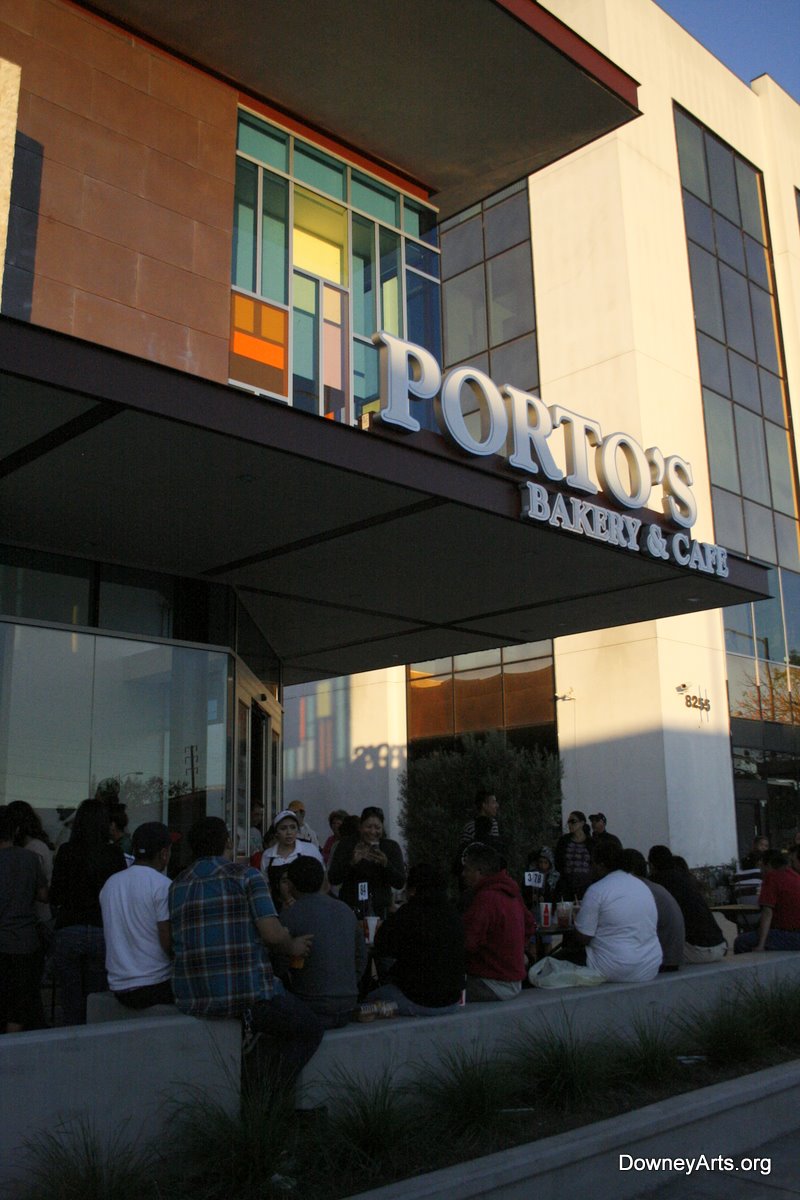
    The significance of Porto’s to the Downey arts scene is yet to be fully scene, but the potential is huge. This is a major, well-liked Southern California business that has taken a big step to make a home in what the city wants to recapture as a vibrant downtown scene. They worked extremely hard to design their building in Mid-Century style architecture, which is a hallmark of Downey’s roots and matches the style of many of our landmarks. The effect is stunning. Raul Porto will tell you that he was about to plug-and-play the same spanish style architecture of their building in Glendale, but then was convinced by the city to change his plans. He wasted about $150,000 going down the “easy” road, until he committed to mid-century and really worked at making his Downey location unique.

    Hopefully more businesses will take notice of the quality of the new Porto’s location and will see how instantly successful it no doubt will be. BJ’s discovered how strong the Downey market is, and a central hub for many people in the area. The opening of the BJ’s in Downey was the biggest opening ever in the history of the company. At the same time, I hope they take notice of the care that Porto’s put into their architecture and design. In addition to a huge spacious restaurant, there is a fairly large outdoor area on the side that I hope can become an evening hang out, perhaps with music and art.

    The Porto family has already become a mainstay here in the community. They’ve had a very busy booth at the Downey Farmer’s Market ever since their new Downey location was announced last year. You can see Betty Porto out there pretty much every week.

    Welcome, Porto family, to Downey.

    Porto’s Bakery Downey